
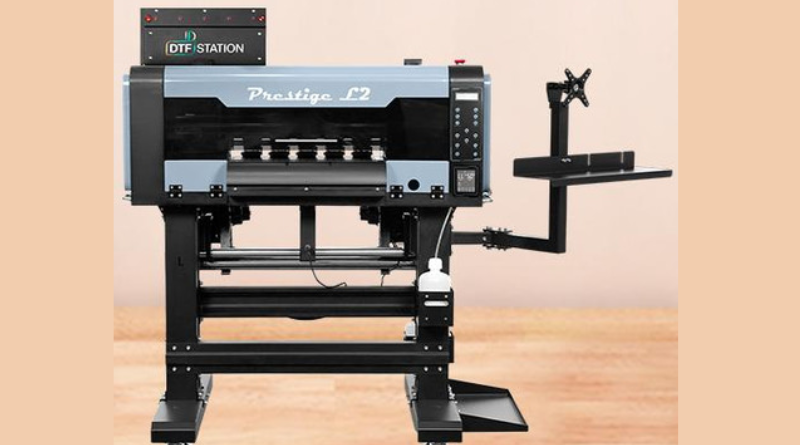
The printing industry has also grown at a very speedy rate with the growth of new digital transfer methods. Two of the most popular among them are DTF (Direct-to-Film) and UV DTF printing, which are now used by apparel decorators, label manufacturers, and small businesses.
Despite the fact that both create high-quality transfers, they are not alike. They give different results that can be applied to various materials. This guide will help you understand the differences between these two printers: DTF and UV DTF. The comparison of both printers’ performance, materials involved, and technology behind them will help you to decide which printer will be suitable to meet your printing goals.
Also, there are some brands that provide versatile solutions like DTF LINKO, depending on your production requirements.
Working Process of DTF Printing vs. UV DTF Printing
DTF printers print on a PET film with CMYK and white water-based inks. In DTF printing, hot-melt powder is then applied to the film after printing. The film is then treated and pressed onto the fabric. The print is resilient, stretchy, and can be used on a variety of fabrics.
Critical elements of DTF printing are:
- Water-based pigment inks
- PET transfer film
- Hot-melt adhesive powder
- Heat press machine
On the other hand, UV DTF printers print on a two-layered film of adhesive that is subjected to UV-curable inks. Such inks are dried immediately using ultraviolet light.
- The design is printed on a raised, glossy sticker that can be applied to hard, smooth surfaces.
- Heat pressing is not necessary in UV DTF printing.
- UV DTF is an ideal choice for customising products and hard surfaces because the film is peeled and placed directly on the surface.
What Makes DTF Printing Unique Compared to UV DTF Printing
DTF printing offers several distinct advantages over UV DTF printing, particularly in the textile industry.
- DTF is used in printing fabrics. When heat is applied, the prints attach to the fibres. UV DTF, however, cannot be applied to clothes since the texture raised becomes hard and uncomfortable.
- DTF prints are paper-thin and flexible. Their stretchiness allows them to be used on T-shirts, hoodies, sportswear, and children’s clothes. On the other hand, UV DTF prints are stiffer and thicker, making them more effective on objects than on clothing.
- DTF inks on water have a high wash resistance and penetrate the fabric coating. The UV DTF inks are hard, material-resistant, and do not bond to fabrics; as a result, they will crack during washing.
- DTF prints are soft-hand when pressed. UV DTF produces a 3D emboss effect, ideal for labels and product branding, but not for clothing.
- UV DTF is ideal for glass, wood, plastic, acrylic, ceramic, metal, and stainless steel. In contrast, DTF is ideal for cotton, fleece, denim, polyester, blends, and dark fabrics.
Key Differences: DTF Printer vs. UV DTF Printer
Ink Type
- In DTF, water-based pigment ink is used. While UV DTF printers use UV-curable resin ink
- DTF printer’s Inks made of water are effective on fabrics. UV inks are effective on hard materials.
Production Method
- In DTF printing, the process of working is printing, applying powder, curing, and then heat pressing. In UV DTF, the process involves printing, UV curing, peeling, and sticking.
- DTF is more step-wise, whereas UV DTF is quicker in the process of curing.
Print Texture
The print texture in DTF is soft and matte, while in UV DTF it is raised and glossy.
Application Range
DTF is specifically for clothing, while UV DTF is for advertising goods, labels, mugs, and bottles.
Common Challenges in DTF Printing in comparison to UV DTF Printing
Despite its great efficiency, DTF printing is associated with several considerations:
- The settlement of white ink needs frequent repairs. White ink is also used in UV printers; however, UV-curable inks do not clog because they are cured immediately.
- DTF powder should be applied uniformly. Excess powder forms thick prints. Excessive weakness leads to low adhesion. UV DTF does not need powder; consequently, it does not face this problem.
- PET film quality directly affects clarity in DTF printing, while DTF films that are based on UV have more stability and give consistent outcomes due to the structured adhesive layer
What printer should you choose?
It depends on the kind of business you are focused on.
- Select DTF printing if your work is mainly shirts, hoodies, uniforms, baby clothes, bags, or other textile goods.
- Select UV DTF printing when you require high-quality labels, branding decals, glass bottle stickers, gift items, or promotional accessories.
Some brands select both DTF and UV DTF printers to increase the variety of products.
Conclusion
Both DTF and UV DTF printing have good potential, although they are not used in the same way. DTF works best on soft fabrics and apparel as it produces flexible, breathable, and durable prints. You may find the best affordable DTF printer from a variety of brands.
UV DTF, however, is ideal for hard surfaces that require a glossy and scratch-resistant professional finish. Knowing the difference between them will allow you to invest in the right technology and build your printing business with confidence. Whether it is the clothing or decoration of your products, the correct method will help you achieve higher customer satisfaction.