
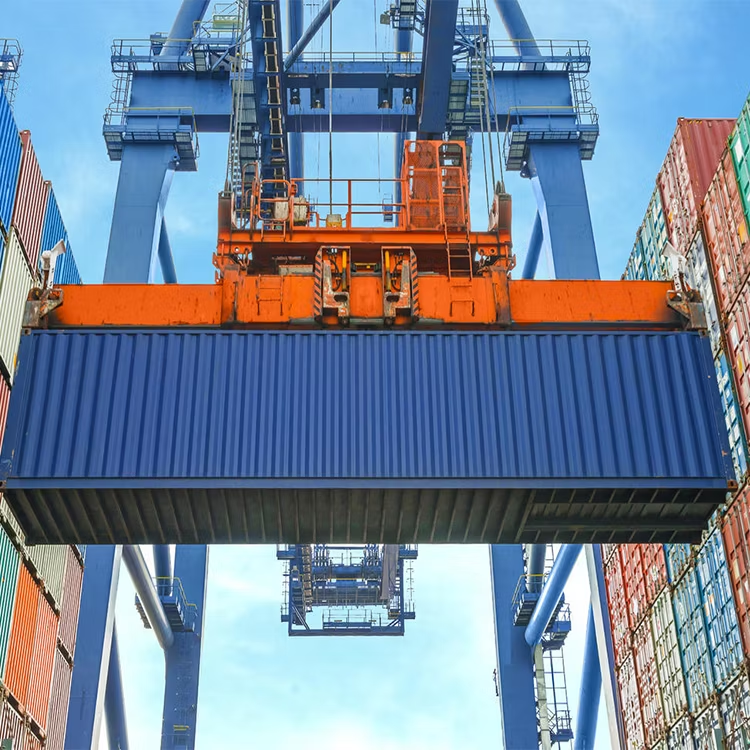
Modern ports are under pressure. Ships are getting bigger, delivery windows are tighter, and expectations for safety and sustainability are rising. In this high‑stakes environment, the often overlooked hero is the container lifting spreader, the piece of equipment that connects towering cranes to the steel boxes that keep global trade moving.
While it may look like a simple metal frame, the spreader is undergoing a quiet revolution. New designs and digital upgrades are turning it from a passive tool into an active part of smarter, safer, and more efficient terminal operations.
Why the humble spreader suddenly matters
In a conventional container yard, the spreader’s job is straightforward: lock onto a container, lift, move, release, repeat. For decades, improvements focused mainly on strength and reliability. That is changing quickly.
Three forces are driving innovation:
- Biggerships and higher stacks are demanding faster
- Toughersafety expectations in busy, confined
- Pressureto cut energy use and emissions without sacrificing
As a result, terminals are rethinking how spreaders are designed, monitored, and integrated into overall port systems.
Safety first in a vertical workplace
Ports remain one of the most hazardous workplaces. Loads swing, weather changes quickly, and humans and machines operate inches apart. Spreader upgrades are becoming a key part of risk reduction.
Newer systems increasingly incorporate:
- Loadmonitoring that detects uneven weight distribution before a
- Sensorsthat verify all twistlocks are engaged, preventing accidental
- Anti‑swayassistance reduces uncontrolled movements in high winds or during ship
- Visualand audible alerts that warn operators about unsafe angles or
These features do not eliminate the need for skilled operators, but they provide an additional layer of protection. In a busy terminal, even small reductions in near misses or minor incidents can have a big impact on downtime, insurance costs, and worker confidence.
From brute force to intelligent lifting
The spreader is also becoming smarter. As ports adopt more digital platforms, the lifting gear is increasingly expected to feed information into the wider system rather than simply obey commands.
Key developments include:
- Embeddedsensors that collect data on cycles, loads, and structural
- Predictivemaintenance, where analysis of that data flags components approaching
- Integrationwith terminal operating systems to track container moves in real
- Remotediagnostics allow technicians to troubleshoot without shutting down operations for long periods.
This shift from reactive to predictive maintenance is particularly important. Instead of waiting for a fault that halts a crane, operators can schedule repairs and part replacements during planned downtime. In a 24/7 port environment, avoiding unplanned stoppages can mean the difference between a smooth week and a backlog that ripples through supply chains.
Adaptability in a changing trade landscape
Standard containers still dominate global trade, but they are no longer the only game in town. Ports increasingly handle:
- Refrigeratedcontainers with specialised
- Oversizedor heavy project cargo that exceeds standard
- Mixedconfigurations on the same vessel
Future‑ready spreaders are being designed with versatility in mind. Adjustable frames, modular components, and the ability to handle multiple container sizes or lifting points make it easier for terminals to adapt to shifting cargo patterns without major retooling.
This adaptability matters as much for smaller regional ports as for global hubs. The ability to handle a wider mix of cargo can open new trade lanes and make a terminal more resilient when volumes in one sector decline.
Automation and the human factor
Much of the conversation about port technology revolves around automation.
Remote‑operated cranes and partially automated yards rely heavily on reliable, predictable lifting equipment. Spreaders used in these environments must meet higher standards of repeatability and communication with control systems.
However, automation does not erase the human factor. Instead, it changes it. Operators move from physically demanding tasks in the crane cab to supervisory roles in control rooms. Clear, intuitive feedback from spreaders and cranes becomes more important, helping teams understand what is happening at the hook in real time, even when they are not on site.
Training is evolving too, with more emphasis on interpreting digital data, recognising early signs of equipment fatigue, and understanding how small abnormalities in lift behaviour might signal a deeper issue.
Toward resilient, low-carbon port operations
Sustainability has moved from a nice‑to‑have to a core requirement. While spreaders are
only one part of the energy picture, their design affects how efficiently cranes operate. Lighter but stronger structures, smoother handling that reduces re‑lifts and damage, and coordination with energy‑optimised crane drives all contribute to lower overall consumption.
In an era when disruptions—from extreme weather to geopolitical shocks—are becoming more common, resilience is just as important as speed. Smarter, safer, and more adaptable lifting technology offers terminals a way to handle volatility without sacrificing reliability.
The spreader may never be the star of glossy port photos. Yet as global trade becomes
more complex and expectations rise, this once‑simple tool is emerging as a quiet indicator
of how prepared a terminal really is for the future.